Panic’s innovative gaming ventures and industry insights
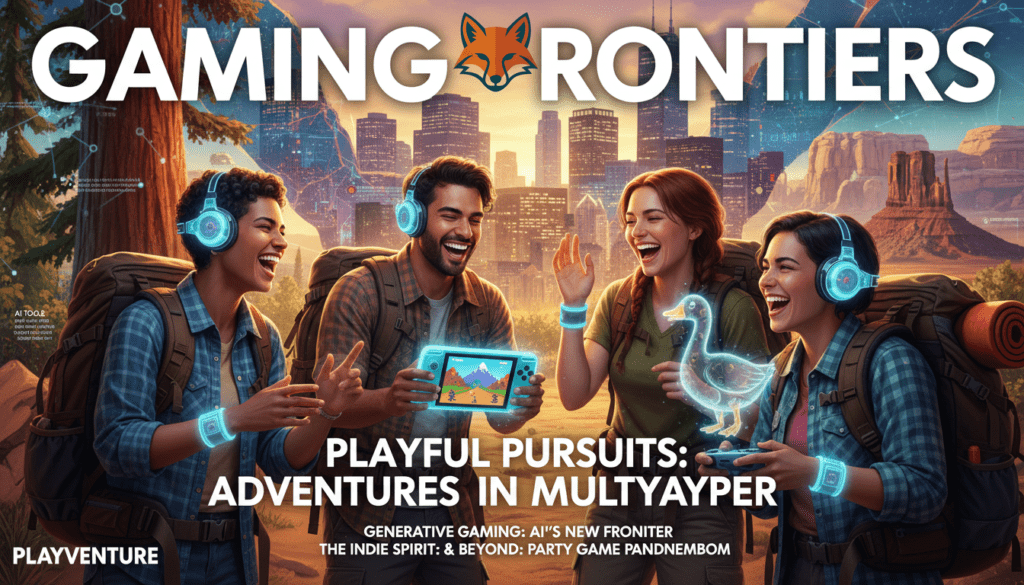
Panic’s innovative gaming ventures and industry insights frame a new model for social play. The studio’s Big Walk transforms casual movement into a co-op spectacle: up to 12 players navigate a playful environment where proximity voice chat reshapes interactions. Its design blends low-friction mechanics with emergent moments, encouraging laughter and improvisation rather than strict competition.
Beyond spectacle, Panic experiments with AI to streamline iteration and spark ideas. Designers use generative tools to prototype behaviors, tune accessibility, and explore unpredictable player-driven narratives. That pragmatic embrace of AI accelerates creative cycles while keeping human authorship central.
This introduction surveys how Panic’s choices — from party-scale multiplayer to AI-augmented workflows — signal broader shifts in the industry. Expect multiplayer systems that privilege presence over precision, licensing strategies that value narrative hooks, and studios adopting small, bold bets to capture attention. In short, Panic is charting an approach that looks less like incremental updates and more like a design-first roadmap for social games to follow.

Panic’s innovative gaming ventures and industry insights
Panic favors bold, counterintuitive choices over safe, incremental updates. Its design philosophy—what team members call doing “the less-obvious thing”—prioritizes presence, humor, and emergent social moments. That mindset produces games that feel alive even with minimal rules.
Key examples and design moves:
- Big Walk: a co-op playground that supports up to 12 players and foregrounds proximity voice chat. Designers focus on low-friction mechanics that enable spontaneous cooperation, playful failure, and shared spectacle rather than tight competitive balance.
- Untitled Goose Game: a compact, personality-first title that sold over one million copies in months. Its commercial success shows how a clear, quirky identity scales without expensive systems.
- AI in the pipeline: Panic uses generative tools to prototype NPC behaviors, propose level layouts, and accelerate iteration. AI suggestions are treated as creative inputs, not final designs, preserving human authorship while shortening feedback loops.
Taken together, these choices reveal a repeatable strategy: amplify simple, social-first systems; lean on distinct personalities; and use AI to iterate faster. The result is a practical roadmap for studios seeking visibility without massive budgets.
| Game | Player capacity | Multiplayer modes | Social interaction innovations | Use of AI | Player engagement methods |
|---|---|---|---|---|---|
| Big Walk | Up to 12 players | Co-op lobbies Shared sessions with proximity voice |
Proximity voice chat to encourage local conversations Low-friction mechanics that enable emergent group moments |
AI used in prototyping and iteration (design-assist) | Shared spectacle and improvisation Short, repeatable sessions |
| Untitled Goose Game | Single-player (social reach beyond play) | Primarily single-player; social via streaming and clips | Strong personality and simple affordances that invite social sharing | Minimal role for AI in core design | Viral moments, memes, social clips, replay for emergent mischief |
| Baldur’s Gate 3 | Small-party co-op (typically up to 4) | Online co-op and local multiplayer | Deep, player-driven narrative choices that foster roleplay | Not central to core design; tooling may assist development | Long-form sessions, emergent storytelling, community mods |
| Monopoly Go | Small-to-medium multiplayer matches (mobile) | Asynchronous and synchronous mobile matches | Familiar board-game mechanics adapted for quick, social mobile play | Limited use in gameplay; analytics for matchmaking/events | Short matches, events, microtransactions, social leaderboards |
| Magic: The Gathering Arena | Primarily 1v1 matches | Online competitive matches, tournaments | Community-driven deck metas and social events | Matchmaking algorithms and backend analytics | Ranked ladders, event play, collectible progression |
Panic’s innovative gaming ventures and industry insights
AI is shifting how games are made and iterated. Industry voices note, “We’re using AI to turbocharge our creative process and improve efficiency.” Studios use generative models for prototyping, behavior scripting, and rapid iteration. That reduces time-to-playtest and widens experimental scope.
Licensing remains a decisive revenue and design lever. Hasbro’s gaming business now exceeds its Mac software arm, and the company is relocating to Boston. About 35–40% of Hasbro’s manufacturing occurs in the U.S. Its licensing portfolio includes Magic: The Gathering, D&D, and Harry Potter. As one executive observed, “Fans have a lot of authority over our brands; listening to them is essential.”
These shifts matter for economics and design:
- Licensing creates cross-platform reach and steady IP income, but raises expectations for fidelity and community engagement.
- Nearshoring and geographic moves change cost models, affect lead times, and influence pricing strategy.
Looking forward, studios that combine AI-augmented design, selective licensing partnerships, and flexible supply chains will manage risk better. As another industry voice put it, “Harry Potter is a multigenerational, gamified brand that still evokes strong loyalty,” underscoring why strategic IP alignments still pay dividends.
Conclusion
Panic’s work demonstrates how focused design choices can reshape how players gather, cooperate, and find delight. By choosing the less-obvious path—building social-first systems like Big Walk and integrating AI as a design accelerator—Panic proves that novelty and clarity can scale both cultural reach and commercial success.
The studio’s playbook is instructive: prioritize presence over precision, craft distinct personalities that invite sharing, and use tools to speed iteration without surrendering authorship. Those moves reduce development friction and increase the odds that small teams produce memorable social experiences.
For readers looking to translate these lessons into their own leisure choices, LeisureQuest is a useful resource for discovering quality activities and structured play opportunities. Visit LeisureQuest to explore curated options that echo Panic’s spirit of exploration, play, and learning.
Panic’s trajectory is a reminder that thoughtful constraints and experimental tooling can produce outsized creative returns—and that social games remain fertile ground for designers who dare to be different.
Frequently Asked Questions (FAQs)
What makes Panic’s approach to multiplayer design different?
Panic focuses on social presence and emergent play rather than complex competitive mechanics. Their systems favor low-friction interactions, brief repeatable sessions, and design cues that spark improvisation. This approach produces memorable shared moments and makes social media discovery easier without requiring massive backend complexity.
How does Panic use AI in its development process?
AI is used as a creative assist tool. Teams use generative models for rapid prototyping, NPC behavior suggestions, and layout exploration. AI outputs inform iteration cycles but do not replace human authorship. The practical goal is faster playtesting and more variations explored per sprint.
Is Big Walk designed for casual groups or core multiplayer audiences?
Big Walk targets a broad social audience. Its capacity and proximity-driven chat support casual groups, mixed-skill gatherings, and streamers. The design emphasizes accessibility and shared spectacle, which helps it work as both a party game and a watchable multiplayer experience.
How do licensing and tabletop franchises influence video game strategy?
Strong licenses like Magic or Harry Potter provide cross-platform reach and reliable monetization. They raise expectations for fidelity and community stewardship. For studios, licensing can justify larger production budgets but demands coordinated IP management and ongoing community engagement.
How can smaller studios apply Panic-like innovation on limited budgets?
Prioritize a single, social-first mechanic and polish it deeply. Use lightweight prototyping and AI-assisted iteration to explore ideas quickly. Favor systems that scale with player creativity rather than expensive content pipelines. Small, distinct design bets often yield outsized cultural attention.