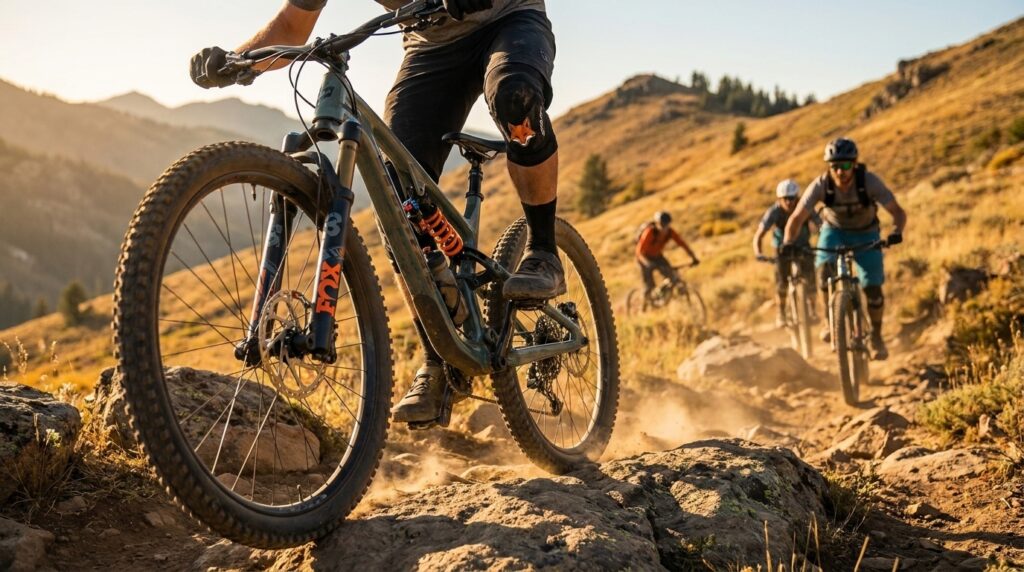
Mountain Bike Suspension
Mountain Bike Suspension sits at the heart of every aggressive trail ride. It soaks up jagged rocks, root gardens, and sudden drops. That keeps your tires planted and your hands calm.
Think of suspension as a tuned system of springs and dampers. The spring—either a metal coil or an air canister—stores the impact energy. A damper controls compression and rebound rates to prevent the bike from bouncing back. Travel length defines how much terrain the system can absorb before bottoming out. Proper setup turns chaotic terrain into a smooth, manageable rhythm.
On steep, rock-strewn descents, well-tuned suspension lets you ride faster with confidence. On long climbs, it prevents wasted energy from constant jolts. In the sections that follow, we’ll explain how suspension components differ, how to match travel and spring type to your riding style, and practical tuning steps for damping and sag. Expect technical detail, clear diagrams, and actionable setup checks.

Mountain Bike Suspension: Types
Mountain bike suspension primarily appears in two frame layouts: hardtail and full suspension. Hardtails use a suspension fork up front only. Full-suspension bikes add a rear shock and linkage. Full systems allow more wheel travel and improved traction on steep, technical terrain. Choice depends on discipline and desired bike behaviour.
Mountain Bike Suspension — Air vs. Coil Springs
Air springs use sealed air chambers to provide spring force. They are lightweight and easy to tune with air pressure and volume spacers. Riders add or remove tokens to change progression.
Coil springs use steel coils for a more linear, consistent feel. They excel at absorbing repeated big hits and returning predictable mid-stroke support. Coil setups are heavier and require spring-rate swaps for major weight changes.
Manufacturers have distinctive takes. Fox Racing pairs Float air springs with high-end damping cartridges. RockShox offers both DebonAir and coil options across the Pike, Lyrik and Zeb lines. Marzocchi focuses on robust, value-forward coil and air forks. Cane Creek highlights tunable characteristics on its shocks and forks with precision damping adjustments.
Mountain Bike Suspension Technology: Travel, Damping, and Control
Suspension travel is the usable distance the fork or shock will compress. Typical ranges: cross-country 80–120 mm, trail 120–140 mm, enduro 150–170 mm, downhill 180–220 mm. More travel increases impact absorption but alters pedalling and geometry.
Oil damping controls the rate the suspension compresses and rebounds. It uses pistons, shim stacks, and calibrated oil passages to shape flow. High-speed damping handles sharp, fast impacts. Low-speed damping manages rider inputs and chassis movement.
Rebound damping slows the spring as it extends after compression. Proper rebound prevents the bike from kicking back and keeps the wheel in contact with the ground. Adjusters on forks and shocks let riders tune rebound click-by-click.
Additional technologies include piggyback reservoirs for thermal stability, compression platforms and climb switches for pedalling efficiency, and bespoke tunes for e‑MTBs to account for battery weight. Models like Fox’s Factory series, RockShox Super Deluxe, Cane Creek’s Double Barrel, and Marzocchi Bomber illustrate the range of engineering choices available.
Mountain Bike Suspension — Quick Comparison
A compact comparison of common suspension types and their key features.
| Suspension Type | Typical Travel | Spring Type | Damping Mechanisms | Relative Weight | Typical Brands / Products |
|---|---|---|---|---|---|
| Hardtail (front fork only) | 80–120 mm | Air (most common) or coil (less common) | Oil-damped cartridge with rebound adjustment | Light | Fox (32/34, SID), RockShox (SID, Recon) |
| Full suspension | 120–220 mm (depending on discipline) | Air or coil (rear shock and fork) | Front and rear oil damping; rebound and compression tuning; linkage damping | Medium to heavy | Fox (Float, Factory series), RockShox (Super Deluxe, Lyrik, Zeb), Cane Creek (DB Inline) |
| e‑MTB suspension | 140–220 mm | Air or coil tuned for extra mass | Enhanced damping, piggyback reservoirs, e‑MTB custom tunes | Heaviest (accounts for battery) | Fox (e‑MTB specific tunes), RockShox (eMTB variants), Marzocchi, Specialized tuned forks |
Mountain Bike Suspension — e‑MTB Specific Systems
Electric mountain bikes change the demands placed on suspension. A typical e‑MTB battery adds roughly 7 to 11 pounds of mass, shifting the center of gravity and increasing puncture loads on suspension components. Manufacturers respond with bespoke valving, revised spring rates, and reinforced internals that preserve control and comfort under sustained power delivery.
Specialized, for example, offers custom‑tuned forks and shocks on many of its e‑MTB models to account for the extra mass and torque. Fox and RockShox provide e‑specific tunes or variants that adjust compression and rebound curves, while Marzocchi and Cane Creek reinforce damping hardware and offer piggyback reservoirs for thermal stability.
Key engineering changes for e‑MTB Mountain Bike Suspension:
- Higher spring rates or air pressures to maintain correct sag under battery weight.
- Firmer low‑speed compression to reduce pedal bob when the motor is applying power.
- Increased high‑speed compression and progressive spring curves to prevent harsh bottom‑outs at speed.
- Slower rebound settings to control mass transfer and keep the wheel planted after big hits.
Thermal management becomes more critical on e‑MTBs. Constant motor-assisted climbs and fast, repeated hits can heat damping oil; piggyback reservoirs and larger oil volumes mitigate fade and maintain consistent damping.
From a rider’s perspective, e‑MTB suspension tuned for these factors translates to steadier cornering, fewer surprise bottom‑outs, and more confidence when pushing pace. When shopping for an e‑MTB, prioritize systems explicitly labeled or tuned for electric assist — they deliver meaningful gains in comfort, traction, and overall performance.
CONCLUSION
Mountain Bike Suspension is the component that defines how a bike reacts to terrain, from cross-country climbs to aggressive downhill runs. Across disciplines, the right combination of travel, spring type, and damping translates to better traction, predictable handling, and rider confidence. Hardtails keep things light and efficient for XC, while full-suspension platforms unlock control on technical trail, enduro, and downhill. e‑MTB-specific systems compensate for battery mass and higher sustained loads, preserving stability and comfort.
Choosing and tuning suspension is as much about matching geometry and travel to riding style as it is about servicing shim stacks, setting sag, and dialing rebound. Brands such as Fox, RockShox, Cane Creek, Marzocchi, and Specialized provide a range of engineering choices—air vs coil, piggyback reservoirs, and tuned damping—to suit different priorities.
If you’re deciding what to prioritize next—upgrading a fork, switching to a coil shock, or buying an e‑MTB—start with ride goals and then use suspension setup to reach them. For curated recommendations and practical next steps, visit LeisureQuest, a guide to quality leisure time that helps people answer “What should I do now?” and inspires exploration and learning: LeisureQuest.
Frequently Asked Questions (FAQs)
How often should I service my mountain bike suspension?
Inspect and clean seals and stanchions after every wet or dusty ride. Lower‑leg or air sleeve service is commonly needed every 50–100 riding hours or once per season. Damper service (oil and shim check) is typically every 100–200 hours. A full rebuild or seal replacement is advisable when damping performance drops, oil leaks appear, or annually for high‑use riders.
Air or coil spring — which should I choose?
Air springs are lighter and easy to tune with pressure and tokens. Coil springs give consistent mid‑stroke support and better heat resistance for repeated big hits. Choose air for cross‑country and general trail use. Choose coil for enduro and downhill or riders prioritizing plush big‑hit performance.
How do I set sag and rebound properly?
Set sag to the travel percentage for your discipline: XC 15–25%, trail 20–30%, enduro/downhill 25–35%. Measure sag with normal riding kit. Start rebound in the middle of its range. If the bike feels bouncy, speed up rebound. If it packs down and doesn’t recover, slow rebound.
Do e‑MTBs need different suspension?
Yes. Batteries add roughly 7–11 pounds and change loading. e‑MTB forks and shocks are often custom tuned with firmer spring rates, revised damping, and better thermal control.
When should I upgrade or replace suspension components?
Upgrade when service cannot restore performance, when travel or geometry no longer matches your riding, or when you want reduced weight or advanced damping features. Consult a pro for compatibility.