Portable Power Banks and Charging Devices: Never Run Out of Power on the Move
Portable Power Banks and Charging Devices are the secret sauce for travelers, gamers, and remote workers. Picture a train platform with one percent battery, a streaming session cut short, or a deadline looming and the laptop warns low battery. Portable chargers and mobile power solutions keep you connected and in control.
Short paragraphs make this easy to scan.
Why this matters
Portable power turns uncertainty into freedom. It enables navigation, content creation, and uninterrupted play. Choose compact travel gear for day trips and high-capacity banks for multi-day adventures.
Key takeaways
- Carry a small 5000 to 10000 mAh pocket charger for daily use
- Use 20000 mAh plus banks for tablets, drones, and longer trips
- Pick USB C Power Delivery for fast chargers and laptop support
- Consider wireless power banks for cable-free convenience
- Look for pass-through charging, safety features, and rugged designs
Quick tips for choosing
- Match wattage to device needs, 45 W plus for many laptops
- Prioritize certified batteries and safety protections
- Check airline rules for battery capacity on flights
Resources and further reading
- Top Tech Deals 2026
- Tech Deals Updates 2026
- Budget Laptops 2026
- USB Power Delivery Documentation
- Wireless Power Consortium
Read on to find the best portable chargers for travel, play, and productivity.
 Related resources
Portable Power Banks and Charging Devices Types and Features
Choosing the right portable power starts with understanding capacity, charging protocols, ports, and extras. This section breaks down options so you match power to purpose.
Portable Power Banks and Charging Devices Capacity Ranges
- Pocket banks 5000 to 10000 mAh. Compact and light. One to three phone charges.
- High capacity banks 20000 to 30000 mAh. Multiple device charges and tablets. Heavier but ideal for road trips.
- Portable power stations often list watt hours (Wh). 100 Wh and above power laptops and small appliances. Check airline rules for batteries above 100 Wh.
Battery capacity is measured in milliampere hours (mAh) and often varies by voltage. Higher mAh equals more stored energy and more weight. Balance weight and runtime for your use case.
Charging Protocols: USB Power Delivery and Quick Charge
- USB Power Delivery (PD) supports higher wattage over USB C. Look for PD 18W, 45W, 65W, 100W for laptops, fast chargers, and tablets.
- Qualcomm Quick Charge and PPS speed up compatible phones and accessories.
- Fast chargers reduce downtime and help maintain productivity on the go.
Port Compatibility: USB C, USB A, and Wireless Qi
- USB C is the current standard for fast charging and data. Prefer USB C PD ports for laptops and newer phones.
- USB A remains common for older devices and accessories.
- Wireless Qi chargers offer cable-free convenience for earbuds and phones. Wireless power banks provide tidy setups for leisure and travel.
Special Features to Consider
- Solar charging panels for off-grid resilience, though slower in practice.
- Rugged designs with IP ratings for dust, water, and shock resistance.
- AC outlet banks and portable power stations for laptops and light appliances.
- Pass-through charging to top up the bank while powering devices.
- Built-in safety chips protect against overcharge, overheat, and shorts.
- Extras like OLED screens, USB meters, and included cables add convenience.
Explore our gear guides and deals
Standards and specs
Comparison Table: Portable Power Banks and Charging Devices — Fast chargers, wireless power banks, portable chargers
Quick at-a-glance table to compare five top picks for travel play and productivity. Use capacity portability and special features to choose the right portable chargers and fast chargers for your needs.
| Brand and Model | Capacity (mAh or Wh) | Number of Ports | Weight | Special Features | Price Range |
|---|---|---|---|---|---|
| Anker PowerCore 10000 PD Redux | 10000 mAh | 2 (1x USB C PD 18W, 1x USB A) | ~195 g | Compact pocket design, USB C PD fast charging | $25–$40 |
| Anker 737 Power Bank (PowerCore 24K) | 24000 mAh | 4 (2x USB C PD, 2x USB A) | ~580 g | High wattage up to 140W, pass-through charging, multi-device | $120–$180 |
| Zendure SuperTank Pro | 26800 mAh | 4 (2x USB C PD, 2x USB A) | ~700 g | 100W+ laptop charging, OLED status display, robust casing | $150–$260 |
| RAVPower Solar Rugged Power Bank | 20000 mAh | 3 (USB C, USB A, micro) | ~450 g | Solar panel, IP67 water dust resistance, rugged for outdoor use | $60–$120 |
| Jackery Explorer 240 Portable Power Station | 240 Wh (~66,000 mAh equiv) | Multiple (AC, USB C, USB A) | ~3.7 kg | AC outlet for laptops and small appliances, ideal for camping | $200–$300 |
Notes
- For daily portability pick small pocket banks.
- For laptop support choose USB C PD 45 W or higher.
- For off-grid use consider solar or power stations.
Resources
Portable Power Banks and Charging Devices for Travel Play and Productivity
Portable Power Banks and Charging Devices remove power anxiety. They keep devices alive when outlets are scarce or unavailable. For travelers and remote workers, this tech gear for travelers is essential.
Travel uses and real life scenarios
- On long layovers, use a pocket portable charger to top up a phone and headphones. You avoid losing access to maps and boarding passes.
- While hiking, a rugged power bank can revive a GPS device and an emergency light. Solar equipped models add extra resilience off grid.
- Road trippers benefit from a high capacity bank that can run tablets and drones. It reduces stops and keeps the journey flowing.
Play and leisure benefits
- Gamers can charge controllers and phones during marathon sessions. Fast chargers cut downtime between matches.
- Outdoor streaming at the beach or park becomes feasible with a lightweight power station for a mini speaker and a tablet.
- Wireless power banks simplify setups for earbuds and modern phones. No cables mean less fuss when relaxing.
Productivity and work scenarios
- Remote workers gain flexibility. A 45 watt plus USB C power bank powers many laptops for remote editing and video calls.
- Coworking days become smoother when shared outlets are limited. Multiple ports let teams charge together.
- Pass through charging and fast charging support maintain workflow while replenishing battery reserves.
Why this matters
Reliability improves safety, convenience, and schedule adherence. Mobile charging convenience translates into more time for exploration, creation, and play. Evidence shows that access to power increases device uptime and reduces stress for travelers and professionals alike.
Further resources and deals
Portable Power Banks and Charging Devices for Travel Play and Productivity
Portable Power Banks and Charging Devices change how you travel, play, and work. They solve the simple problem of dead batteries. They keep navigation apps running. They power cameras and laptops. They let you keep streaming or gaming without pause.
Travel layovers and transit
- At an airport or train station, a pocket portable charger keeps your phone alive for maps, tickets, and last minute calls. One small bank removes the scramble to find an outlet.
- During long layovers, you can top up a tablet and headphones. That means entertainment and rest without hunting for power.
Hiking road trips and outdoor use
- Rugged power banks with IP ratings and solar panels keep GPS devices, lights, and cameras working off grid. They add a safety layer for remote routes.
- On long drives, a high capacity bank powers tablets, drones, and even small fridges. It reduces stops and keeps your itinerary moving.
Gaming sessions and outdoor streaming
- Fast chargers restore controllers, phones, and headsets between rounds. Less downtime helps keep the momentum of competitive play.
- For outdoor streaming, a lightweight power station runs a camera and a speaker for hours. Wireless power banks reduce cable clutter when you broadcast from a park or beach.
Remote work and productivity
- A 45 watt or higher USB C PD power bank runs many laptops for editing video and joining video calls. That enables work from cafes, parks, and coworking spaces.
- Multiple port banks let teams share power during coworking days. Pass through charging keeps your bank ready while you work.
How these devices reduce stress and increase device uptime
- Predictable power means fewer interruptions and more control over your schedule.
- Mobile charging convenience removes frantic searches for outlets.
- Reliable tech gear for travelers protects deadlines, uploads, and live sessions.
Explore gear picks and deals at LeisureQuest and stay powered on every quest
CONCLUSION
Portable Power Banks and Charging Devices are essential companions for anyone who values mobility reliability and uninterrupted leisure or work. Whether you are hopping through airports, trekking off grid, streaming an outdoor set, or editing video from a cafe, the right portable chargers keep your devices charged and your plans on track.
Key benefits at a glance
- Freedom to explore without hunting for outlets
- Less stress during travel and live sessions
- Greater uptime for gaming streaming and remote work
- Flexibility to choose pocketable chargers solar rugged banks or compact power stations
At LeisureQuest we believe quality leisure time matters. Our mission is to help you turn free time into engaging quests by curating gear guides, testing recommendations, and deal roundups that make choosing travel gear and mobile power solutions simple and reliable. Find curated picks and ongoing tech deals to match your needs:
Explore more and power your next adventure at LeisureQuest.
Frequently Asked Questions (FAQs)
This FAQ focuses on plain-language definitions of technical terms and clear answers to common questions so non-technical readers can choose and use portable power banks with confidence.
Quick definitions (plain language + analogies)
- Watt-hours (Wh): Think of Wh as the total amount of “fuel” in a battery’s tank. If a lamp uses 10 watts, a 100 Wh battery can run it for about 10 hours (100 ÷ 10 = 10). Wh is the most accurate way to compare batteries, especially for power stations.
- milliampere-hours (mAh): mAh is another way battery capacity is listed for phone-sized batteries. It’s like saying how many milliliters of fuel are in the tank, but fuel pressure (voltage) matters too. Because device voltages vary, mAh isn’t directly comparable across different battery types without conversion — use Wh when possible.
- Watts (W): Watts measure how fast energy is used or delivered — like the flow rate from a faucet. A higher-watt charger fills your device faster, but the device can only accept as much as it’s built to handle.
- Voltage (V): Voltage is like water pressure that pushes electricity through a device. Wattage = Volts × Amps. So both pressure and flow matter to get the right power.
- USB Power Delivery (PD): PD is a smart charging “faucet.” It lets the charger and device talk to decide the best voltage and current (wattage) to deliver safely and quickly. Look for PD ratings like 18W, 45W, 65W, or 100W to match laptops or phones.
- PPS (Programmable Power Supply) and Quick Charge: These are faster-charging standards that allow flexible voltage changes for compatible phones and devices.
- Qi (wireless charging): Qi is the common wireless standard for phones and earbuds. Wireless power banks have a Qi pad so you can charge without plugging a cable into the device.
- Pass-through charging: This lets a power bank charge a device while the bank itself is plugged in and recharging. Useful, but not all banks support it — check specs.
Brief answers to common questions
Which number should I trust — Wh or mAh?
Wh is more reliable for comparing energy across different batteries. Convert mAh to Wh only when you know the battery voltage.
What wattage do I need for a laptop?
Match or exceed the laptop’s charger wattage. Many modern laptops work well with 45W–65W PD; power-hungry models may need 100W.
What about flights and batteries?
Airlines generally limit batteries to 100 Wh in carry-on without approval. Larger power stations often require airline approval — always check your airline rules.
Further resources
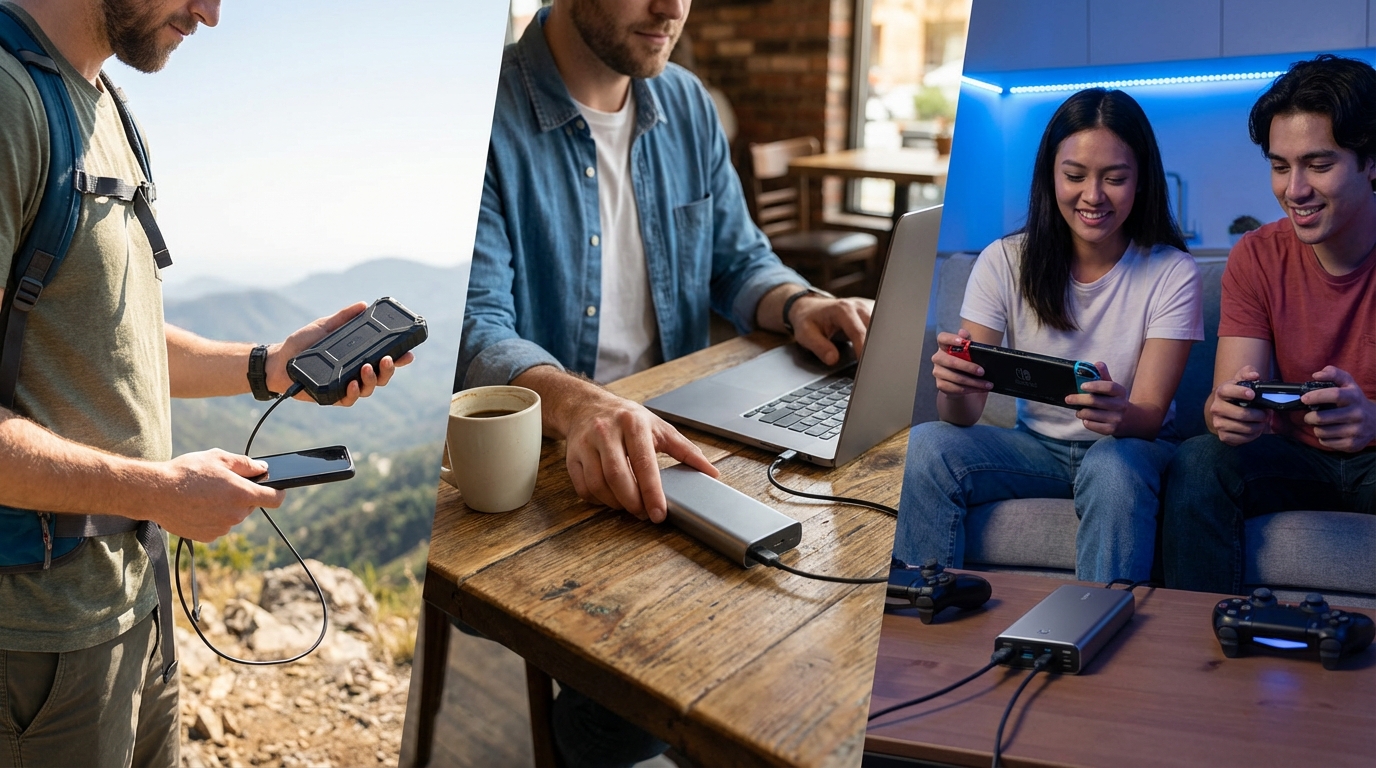
A high quality photo shows three scenes side by side: a hiker charging a phone from a rugged power bank at a scenic overlook; a remote worker powering a laptop with a sleek USB C bank in a cafe; friends charging controllers and a handheld console during a gaming session. No text or logos. Vivid colors and clear focus emphasize mobility and seamless power access.
Related resources