Educational DIY Space Dice Kit: A Playful Beginner Electronics Project
Meet the Educational DIY Space Dice Kit, a beginner-friendly, playful DIY electronics project that marries a vintage sci-fi space laser sound generator with a six-sided die roller. It’s designed to teach core electronics skills while keeping the process fun.
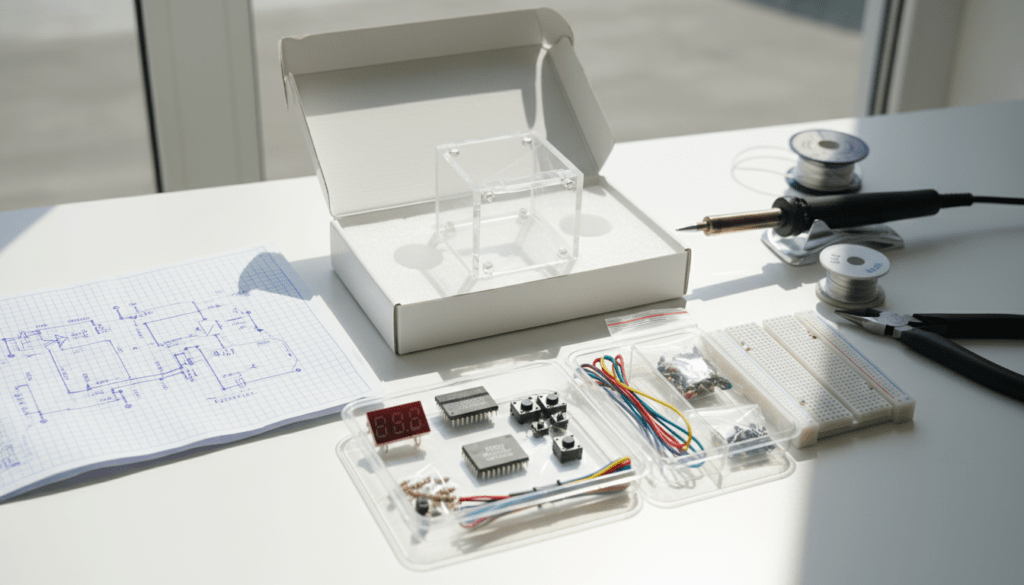
You will solder simple parts, follow a clear schematic, and watch logic come to life. The kit produces quirky, retro laser sounds as you roll a physical die outcome. That combination turns abstract concepts into tangible play.
This introduction will guide curious beginners, hobbyists, and teachers toward hands-on learning. Expect clear step-by-step assembly, simple troubleshooting tips, and creative customization ideas you can try after the build. No prior experience is required, only curiosity and a few basic tools.
Whether you want a weekend project, a classroom demo, or a uniquely noisy game accessory, the Space Dice kit delivers both learning and delight. Read on to discover parts, the build process, and ways to personalize the sound and enclosure.
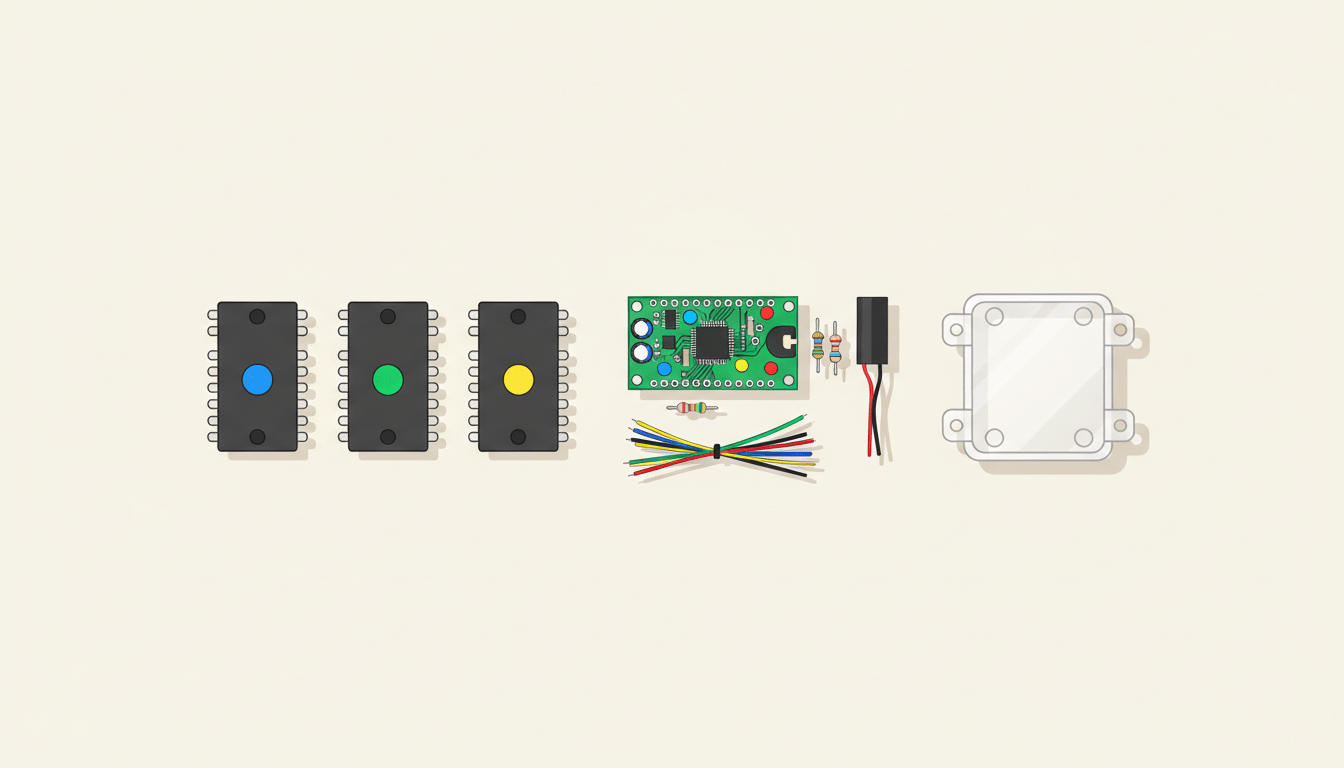
A colorful flat-lay illustration of the Educational DIY Space Dice Kit components: three distinguishable DIP CMOS ICs, a partially built through-hole PCB with LEDs, resistors, capacitors, a piezo speaker, battery clip, jumper wires, and the snap-together compact enclosure assembled without fasteners.
How the Educational DIY Space Dice Kit Works
The Educational DIY Space Dice Kit uses three CMOS logic chips to produce both sound and a six-sided die mechanism—without a microcontroller. This transparent design places logic gates, counters, and oscillators front and center. Beginners can see how digital building blocks interact.
Educational DIY Space Dice Kit — Sound generation with the CD4093
The CD4093 is a quad NAND gate with Schmitt inputs. In this kit, a pair of its gates form relaxation oscillators that create the core square-wave tones. Unused gates are repurposed as simple waveform shapers and mixers to add harmonic sparkle and decay. Those gates drive a piezo speaker through a small passive filter and coupling capacitor. Changing resistor or capacitor values alters pitch and envelope, making the vintage space-laser timbre easy to tweak and learn from.
Educational DIY Space Dice Kit — Die rolling with CD4040 and CD4017
The CD4040 is a binary counter/divider that derives slower clock divisions from the primary oscillator. The CD4017 is a decade (Johnson) counter that advances one output per clock pulse. When you trigger a roll, the kit clocks the CD4017 rapidly so its outputs cycle like a spinning selector. Stopping the clock leaves one output active, which the circuit maps to a die face. The CD4040’s divided signals and gating logic help introduce irregular stop timing, so results look unpredictable rather than perfectly periodic.
At a glance, chip roles in the Educational DIY Space Dice Kit:
- CD4093: oscillators, sound shaping, and clock source.
- CD4040: frequency division and pseudo-random timing control.
- CD4017: sequential output selector mapped to six die faces.
The all-CMOS approach removes firmware complexity. It gives tangible lessons in counting, timing, and wave shaping. Builders can probe signals with a meter, swap passive values, add LEDs, or modify the enclosure acoustics. That hands-on feedback is what makes the Space Dice both a playful toy and a practical learning tool.
| Chip | Chip type | Function in kit | Role in the Educational DIY Space Dice Kit | User benefits |
|---|---|---|---|---|
| CD4093 | Quad NAND with Schmitt inputs | Generates oscillators and shapes audio waveforms | Primary clock and sound engine; unused gates repurposed for timbre and envelope shaping | Simple to solder; clear cause-and-effect for tone changes; great for learning oscillators and logic gating |
| CD4040 | Binary counter/divider | Divides the high-speed clock into slower timing signals | Produces time bases and pseudo-random timing used to vary stop timing and control gating | Demonstrates binary counting and frequency division; easy debugging with a multimeter or LED indicators |
| CD4017 | Decade (Johnson) counter | Sequentially enables outputs per clock pulse | Acts as the six-face selector during a roll; cycles outputs quickly then stops on one face | Visual mapping of counter outputs to die faces; intuitive for beginners to trace sequence behavior |
Educational DIY Space Dice Kit — Assembly Experience and Practical Uses
The kit is designed so the enclosure snaps together without screws or glue. That reduces fiddly steps and keeps the focus on soldering and circuit behavior. The compact housing holds the PCB, battery, and speaker in a tidy layout that’s forgiving for first builds.
Assembly is approachable. Parts are through-hole and labeled on the silkscreen. Most builders finish the soldering in one afternoon. The low parts count keeps error sources minimal, which helps beginners learn how each component affects the final behavior.
Practical uses extend beyond a novelty gadget. The Space Dice works as a lightweight gaming accessory for tabletop sessions. It also shines as a classroom demo or maker-station project that demonstrates counting, timing, and simple analog sound shaping without code.
Assembly tips
- Sort and check parts before starting; confirm chip orientations and polarity marks.
- Solder small components first, then larger parts to keep the board flat.
- Use a low-wattage iron and clean tip to avoid overheating CMOS chips.
- Test the circuit on a bench before snapping the enclosure closed to simplify troubleshooting.
- If a gate or LED doesn’t behave, probe power and ground pins first; loose solder joints are the usual culprit.
- Keep a small container for screws and leftover parts during the build.
Activities and classroom ideas
- Game nights: replace dice rolls with Space Dice for a retro-sci-fi twist.
- Demonstrations: show how counters and sequencers create predictable sequences.
- Sound experiments: swap resistors or capacitors to hear how timbre changes.
- Extension builds: add external LEDs or mount the board in a transparent case to reveal the inner logic.
- Quick group workshop: pair students to solder, test, and present one modification.
The Educational DIY Space Dice Kit blends a satisfying hands-on build with versatile practical uses. It’s both a playful accessory and a compact teaching tool for beginner electronics.
Conclusion
The Educational DIY Space Dice Kit delivers immediate, hands-on learning through a playful project. Builders solder parts, test functions, and hear results. That sensory feedback turns abstract concepts into memorable lessons.
It’s ideal for first-time electronics hobbyists, classroom activities, and anyone who enjoys tinkering. The kit lowers the barrier to entry and rewards curiosity. Small experiments, part swaps, and display mods invite iteration and teach troubleshooting skills.
LeisureQuest champions projects like this. We curate clear guides, practical tips, and project ideas that help people explore, play, and keep learning. Whether you want a quick weekend build or a classroom module, you’ll find inspiration and step-by-step help.
Ready to try more hands-on projects? Visit LeisureQuest to discover other DIY kits, tutorials, and hobby resources. Build, experiment, and share your results—then keep exploring. The best learning happens when play meets practice.
Join the community to ask questions, show your modifications, and learn from others.
Frequently Asked Questions (FAQs)
What skill level is the Educational DIY Space Dice Kit aimed at?
– Beginner to early-intermediate. Parts are through-hole and clearly labeled.
– Basic soldering and component-identification skills make the build faster.
– Expect a one-afternoon build time for first-timers.
What core components are included and why do they matter?
– The kit centers on CMOS logic chips, a small speaker, LEDs, resistors, capacitors, and a battery holder.
– These parts let you observe how oscillators, counters, and gates create sound and sequence outputs.
– No microcontroller means the behavior is purely hardware-driven and easy to trace.
How does the kit help with learning electronics?
– It demonstrates timing, counting, and waveform creation in a tangible way.
– Builders practice soldering, signal tracing, and simple measurements with a multimeter.
– Modifying resistor or capacitor values gives immediate audible feedback.
What practical uses and activities work well with the kit?
– A tabletop gaming dice substitute with retro sci-fi sound effects.
– Classroom demos on binary counting and sequencing.
– Sound-design experiments, extension projects with LEDs, or group soldering workshops.
Any assembly tips to avoid common problems?
– Inspect parts and orient ICs before soldering.
– Solder small parts first, then larger ones.
– Use IC sockets if you plan to swap chips.
– Test the board on a bench before closing the enclosure.
– Disconnect the battery when storing the kit.