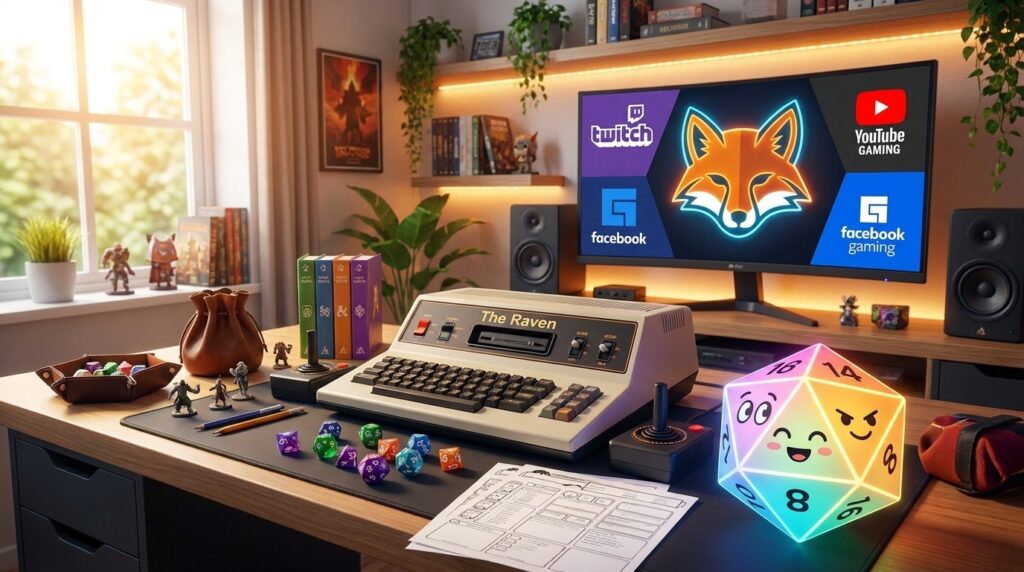
Innovative Gaming and Streaming Technologies in 2026 are reshaping how we play, watch, and tinker. This year mixes high-performance cloud streaming, immersive local hardware, and playful maker culture. Expect lower latency, smarter live interactions, and more accessible retro recreations. But the real fun lies where bleeding-edge tech meets tabletop curios.
In this guide, we spotlight unusual projects worth trying during gaming nights and hack sessions. You will meet a slightly sentient d20 that tracks lucky streaks. We explore homebrew Atari clones built around Motorola processors, ROM-hacking tips, and modern GEM/TOS revival projects. There are ideas for converting classic cabinets, building quirky dice electronics, and streaming retro tournaments. Each piece balances hands-on making with fresh streaming tools. Whether you want to mod hardware, host sense-of-wonder streams, or run hybrid online-tabletop sessions, this article shows where to start.
Read on for step-by-step projects, streaming setups, and sources so you can test these ideas yourself.
Tabletop Oddities Featuring Innovative Gaming and Streaming Technologies in 2026
The tabletop scene has always welcomed strange tools. Recent maker-driven projects push that further with reactive dice, smart accessories, and novel random number generator mechanics. A standout is the slightly sentient d20: an embedded-microcontroller die that tracks streaks of results and expresses a ‘mood’ through light, vibration, and companion messages.
How the sentient d20 works
- Motion and orientation sensors read each roll; a tiny MCU classifies outcomes as lucky or unlucky.
- A local streak counter adjusts mood states: neutral, exuberant, sulky.
- Outputs include RGB LEDs, haptic pulses, and optional voice chimes or app notifications.
Design notes and play ideas
- ‘The idea is to create (and feed) the feeling of lucky and unlucky streaks.’ Use adaptive narration: when the die is ‘sulky’ introduce penalties or roleplay beats.
- Keep ethics in mind: ‘Gamers are of course perfectly capable of projecting such feelings all on their own.’ The device should enhance, not dictate, table mood.
RNG and mechanics to try
- Hybrid entropy: combine an onboard physical RNG (noise diode or ring-oscillator) with a deterministic PRNG for repeatable effects.
- Weighted-face firmware: allow players to tune probabilities for certain game modes.
- Event triggers: streak thresholds can spawn in-game boons, chat alerts, or stream overlays.
RPG accessories worth building
- Sensor-lined dice trays for reliable roll detection.
- Modular PCBs to retrofit classic dice with LEDs and BLE.
- Tabletop hubs that log sessions and export roll histories for VTT integration.
These oddities blur hardware hacking with table storytelling. They make tabletop gaming tactile, surprising, and stream-friendly without replacing player agency.

Raven Atari Clone and GEM/TOS Applications — Innovative Gaming and Streaming Technologies in 2026
The Raven is a modern Atari clone computer built for enthusiasts who want authentic 68k performance with hobbyist-friendly expansion. At its heart sits a Motorola 68060 CPU and it supports up to 48 MB of RAM, which places it well above the original Atari ST era machines in raw processing power.
Why the Motorola 68060 matters
- Late-generation 68k core with stronger integer and floating-point performance than earlier 68k chips.
- Improved throughput helps classic demos, emulators, and multitasking GEM applications run more fluidly.
- The architecture remains compatible with many Atari-era binaries, easing software reuse.
Typical Raven technical highlights
- CPU: Motorola 68060 (compatible with 68k toolchains).
- Memory: expandable up to 48 MB RAM for larger applications and buffers.
- Storage and I/O: designed for hobbyist upgrades and common adapter interfaces so modern media can be used alongside legacy peripherals.
- Expansion: open PCB and connector layouts that invite community mods and daughterboards.
GEM/TOS applications and practical uses
- GEM/TOS provides a lightweight graphical desktop and API for drawing, windows, and input handling.
- Use cases include retro productivity tools, pixel-art editors, music trackers, and native games.
- Developers often cross-compile on modern machines, test in emulators, and deploy to Raven hardware for final runs.
Community support
- Exxos Forum and Hackaday are active hubs for schematics, firmware hacks, and project write-ups.
- These communities publish adapter designs, boot images, and troubleshooting tips that make Raven projects approachable.
For makers, Raven devices offer a clear bridge between authentic retro software and modern maker workflows, ideal for restoration projects, demo scenes, and creativity that plays well on stream.
| Service | Primary focus | Key features for gamers/streamers | Documentary & curated content | Unique offering for gamers/streaming audiences |
|---|---|---|---|---|
| Paramount+ | Premium VOD and linear TV | On-demand streaming, watch-party features, platform apps and mobile playback | Console Wars, gaming documentaries, short-form true-crime shorts and curated retrospectives | Licensed classic content and curated gaming-history documentaries that pair well with retro streams |
| Twitch | Live game streaming and community | Low-latency chat, extensions, subscriptions, bits, clips, raids, co-streaming tools | Occasional premieres and creator-produced documentary-style series | Real-time interactivity and highly integrated creator monetization tools |
| YouTube | VOD and live video platform | VOD archive, Shorts, live premieres, editor tools, discovery and monetization | Large library of retrospectives, feature docs, and creator-made longform pieces | Massive discoverability and flexible VOD + live workflows |
| Netflix | Premium subscription VOD | High-production originals, global delivery, robust player features | Big-budget documentaries and series touching gaming culture | High-profile documentary releases and cinematic presentation |
| Xbox Cloud Gaming (Game Pass Cloud) | Cloud play-and-stream ecosystem | Play-on-demand streaming, capture and sharing, Game Pass integration across devices | Limited native docs; ties to Xbox studio releases and companion content | Seamless transition between watching and instantly playing supported titles |
| NVIDIA GeForce Now | Hardware-agnostic cloud gaming | Low-latency high-performance streaming, broad device support, native capture | Minimal documentary catalog | Focused on performance and bringing PC libraries to lightweight clients |
Conclusion
Innovative Gaming and Streaming Technologies in 2026 illustrated how maker culture, retro revival, and low-latency streaming reshape play and storytelling. The article paired hands-on tabletop oddities with practical retro projects and modern streaming workflows to spark new play sessions and creative streams.
Key takeaways:
- Tabletop oddities make sessions tactile and unpredictable, from mood-aware dice to novel RNG mechanics.
- Raven and other Atari clone computers (Motorola 68060, expanded RAM, GEM/TOS) show how vintage platforms remain fertile grounds for modern development and creative demos.
- Streaming ecosystems and documentary content let creators connect play, history, and audience interaction in richer ways.
These developments invite players to learn by building, to stream by showing process, and to teach through play. LeisureQuest exists to help people turn free time into engaging quests through exploration, play, and learning. Find more projects, guides, and community links at LeisureQuest.
Frequently Asked Questions (FAQs)
What is a “sentient d20” and is it practical at my gaming table?
A sentient d20 is a prop that uses motion/orientation sensors and a microcontroller to register rolls and react with LEDs, haptics, or app messages. It’s practical as a theatrical, optional accessory that creates stream-friendly moments—keep it optional so it never overrides player agency.
How do the random number generator (RNG) systems in these oddities work?
Many projects use hybrid entropy: a physical source (noise diode or ring oscillator) seeds a PRNG so you get true randomness plus reproducibility for demos and overlays. Log raw entropy if you need auditability for competitive events.
How do I set up GEM/TOS (or alternatives) on a Raven-class Atari clone? Step-by-step
Step 1 — prepare hardware: install SIMM RAM, attach power, and connect an SD/CF adapter or IDE drive per the Raven build notes.
Step 2 — choose OS: use open options like EmuTOS or FreeMiNT. If you want official TOS, obtain ROMs legally and confirm compatibility.
Step 3 — test images in an emulator: use Hatari to verify your TOS/EmuTOS image and desktop configuration before touching hardware.
Step 4 — prepare boot media: follow the Raven thread on Exxos for exact file placement and image formats. Copy EmuTOS/TOS files to the SD/CF root and set any Raven-specific boot flags per the thread.
Step 5 — first boot & troubleshooting: use a serial console or video output to watch boot messages. Check ROM sizes, jumper settings, and IRQ mappings if it stalls; the Exxos thread and Hackaday write-up are good troubleshooting references.
Where can I find help and resources for retro hardware projects?
Active hubs: Exxos Forum (link above), Hackaday project pages, and GitHub repos for EmuTOS and FreeMiNT. Search those threads before hardware mods.
Are Paramount+ documentaries suitable for streaming-related content and research?
Yes for background research (titles like Console Wars), but check licensing and fair-use before including clips in monetized streams.