Ultralight quilts for backpacking are changing how weekend and shoulder-season campers think about sleep systems. Choosing the right sleep system feels simple until you pack your pack and realize every ounce and inch matters. Do you go with a traditional mummy sleeping bag that encases you, or a minimalist quilt that sheds weight and bulk? Many close-to-home backpackers face this exact dilemma: comfort, warmth, and versatility versus weight and packability. This article compares ultralight quilts and sleeping bags so you can decide which system fits your trips and priorities.
Read on to explore real benefits, trade-offs, and practical tips for using quilts in the field. We’ll cover warmth-to-weight comparisons, key design differences, temperature management, and common setup mistakes. Whether you’re aiming to shave ounces for a quick overnight or rethinking your three-season kit, you’ll get clear guidance to choose confidently.
By the end you’ll know whether a quilt’s warmth-to-weight advantage matters for your routes and budget.
Ultralight quilts for backpacking: How they compare to sleeping bags
Ultralight quilts for backpacking deliver the biggest advantage one thing-minded hikers care about most: fewer ounces without a proportional loss in warmth. Quilts remove the insulated hood and full perimeter baffle of a mummy bag, trading enclosure for weight savings and compressibility.
Weight and warmth-to-weight
Quilts typically shave several ounces to a pound or more versus comparable-rated sleeping bags. That translates directly into less bulk on the outside of your pack and a higher warmth-to-weight ratio for many down quilts. For example, ultralight options often fall into the 20–30 ounce range, while full-featured three-season mummy bags commonly weigh noticeably more once you add hood and draft collar.
Design differences at a glance
- Insulation coverage: Quilts drop the insulated hood and often the back panel; sleeping bags insulate fully around you.
- Warmth-to-weight: Quilts maximize down where it matters (over your torso) to increase efficiency.
- Packability: Quilts compress smaller because they use less overall fill.
- Versatility: Quilts pair easily with different pads and can be layered for variable temperatures.
Typical use cases where quilts shine
- Summer overnight trips where freezing temperatures are unlikely.
- Shoulder-season hikes where you can combine a quilt with a warmer pad or clothes.
- Fast-and-light overnight or weekend missions where every ounce counts.
- Close-to-home camping where you can bail early if weather worsens.
When a quilt is the better choice
Choose a quilt if you prioritize weight savings, sleep on your back or don’t toss much at night, and plan trips within predictable temperature ranges. Quilts also make sense when you already own a high-performance sleeping pad that prevents heat loss to the ground. If you want the simplest path to lighter packing without sacrificing core warmth, an ultralight quilt is often the most efficient upgrade.

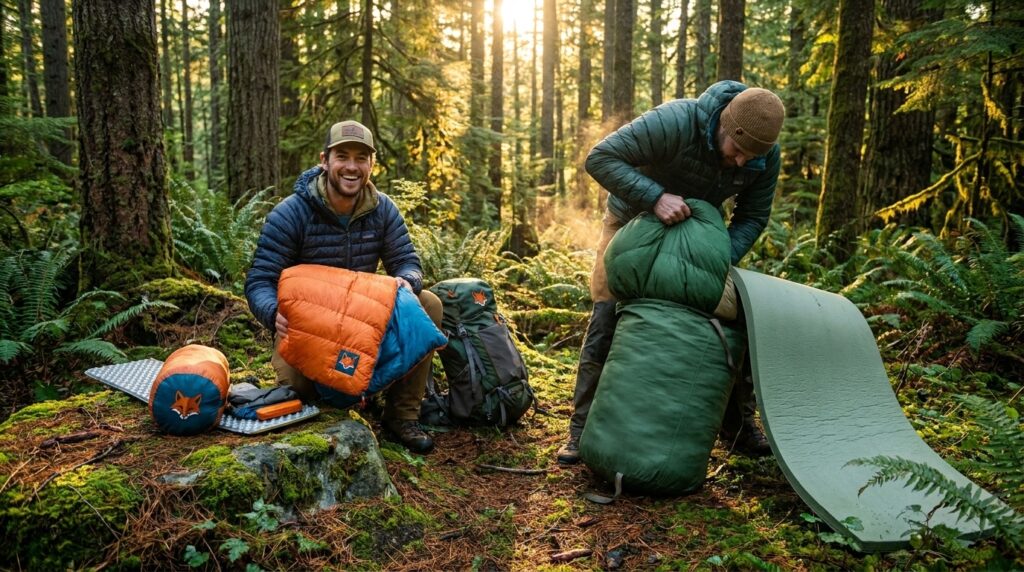
Image shows a side-by-side campsite comparison: an ultralight quilt on an inflatable pad on the left and a traditional mummy sleeping bag on the right. Each setup includes a packed backpack for scale to emphasize weight and bulk differences.
| Product | Type | Weight (approx.) | Down Fill Power | Price Range (USD) | Special Features & Comfort |
|---|---|---|---|---|---|
| Enlightened Equipment — Revelation quilt | Quilt | 22.5 oz | 850-fill duck down | Varies (custom options) | Ultralight, excellent warmth-to-weight; minimalist hoodless design requires a good pad for insulation under the back. Comfortable for back sleepers; highly compressible. |
| REI — Magma Trail Quilt | Quilt | ~19–22 oz (model dependent) | Down (fill varies by model) | Often under $250 during sales | Lightweight, affordable trail-focused quilt; designed for packability and quick trips. Good balance of comfort and low bulk. |
| Zenbivy — 25° Convertible Light Quilt | Quilt (system) | 24 oz (quilt); 33 oz (full system w/ sheet) | Down (fill varies by configuration) | Mid-range (varies) | Includes hood and draft collar when used as a system; more like a hybrid between quilt and bag for added draft protection and easier use at cooler temps. |
| Therm-a-Rest — NeoAir XLite NXT | Inflatable sleeping pad | ~13 oz (regular) | N/A | ~$199–$220 | High-performance, ultralight air pad that pairs well with quilts to prevent underside heat loss; crucial for comfort and warmth with quilt systems. |
| Exped — Ultra 6.5R | Inflatable sleeping pad | ~21 oz (medium) | N/A | ~$200–$300 | Thicker, higher-R-value pad for colder nights; heavier than ultralight pads but improves comfort and insulation when using a quilt. |
Notes: We focused on representative product specs and practical benefits. Quilts concentrate down where it matters, improving warmth-to-weight and compressibility. Pairing a quilt with a high-performance pad (like the NeoAir XLite NXT or Exped Ultra series) addresses the primary weakness of quilts: underbody heat loss.
Draft protection and versatility of quilts
Quilts can look simple on the spec sheet, but practical features make them usable across more conditions than many expect. Draft protection focuses on two problems: cold air entering around the neck and heat escaping through the underside. Manufacturers and users address both with attachments, collars, and smart layering.
How manufacturers add draft protection
- Hood and draft collar systems: Zenbivy’s 25° Convertible Light Quilt shows how a quilt can borrow sleeping-bag features. When used as a full system, the included hood and draft collar lock warmth near the shoulders and neck without the weight of a full mummy hood.
- Footbox and cinch options: Some quilts add adjustable footboxes or cinch cords that let you reduce dead air space when temperatures drop.
- Hybrid designs: Models such as the Revelation offer minimalist profiles but rely on pad compatibility and clothing layers; others blend quilt and bag elements to improve seal and comfort.
Practical setup tips for better draft control
- Use a high-R pad and ensure good pad-to-quilt contact; straps or pad sleeves stop gaps.
- Add a thin liner or wear an insulated midlayer when temps hover near the quilt’s limit.
- Tuck the quilt under your shoulders and use the cinch/cords to close gaps around the neck.
- For restless sleepers, try a convertible system (Zenbivy-style) that adds a hood when needed.
Real-world versatility
Quilts handle summer and shoulder-season trips with ease when paired correctly. In cooler or less predictable weather, choose a quilt with an optional hood/collar or plan to layer. As one reviewer put it, “There’s nothing about a mummy that I want to emulate, not even when I’m sleeping.” At the same time, “The point here isn’t to say that quilts are always the best choice, rather that sometimes they absolutely are the best choice and you should give them a try.” Those two lines capture the balance: quilts can be both lightweight and practical when design and setup match the conditions.
Conclusion
Ultralight quilts for backpacking offer a clear, practical benefit for close-to-home and fast-and-light trips: significantly lower weight and better warmth-to-weight when paired with a quality pad. They shrink pack bulk, let you concentrate insulation where it’s needed, and— with hybrid features like Zenbivy’s hood and draft collar—handle shoulder-season variability without becoming fussy.
Quilts aren’t a one-size-fits-all replacement for mummy bags; choose them when predictable temps, a good pad, and your sleep style align. For campers who prioritize ounce savings, packability, and simplicity, a quilt is often the smarter choice.
Curious to explore options and real-world tips? LeisureQuest curates gear guidance and trip ideas to help you get outside, play, and keep learning.
Consider a quilt for your next sleep-system upgrade—you may be surprised how much weight and hassle you can leave behind.
Frequently Asked Questions (FAQs)
Are ultralight quilts warm enough for backpacking?
Yes, when used as part of a system. Pick a quilt rated for expected lows, pair it with an insulated pad, and add a thin liner or midlayer if nights dip. Shelter choice and wind exposure also affect comfort.
How much weight will I actually save compared to a sleeping bag?
Savings vary by model and features, but quilts remove heavy hood and perimeter insulation common to mummy bags. Expect a noticeable reduction in pack bulk and easier compression. Remember to count pad and any accessory weight when comparing systems.
Will I be comfortable if I move a lot during the night?
Restless sleepers can adapt. Look for quilts with adjustable footboxes, cinch cords, or convertible systems that add a hood. Use pad straps or a sleeve to stop shifting. Test setups at home before a multi-night trip.
Do quilts need special pads or liners?
Use a pad with good R-value and the right width. Secure the quilt to prevent gaps—pad straps, sleeve, or attachment points help. Liners add warmth and are easy to wash; they also increase temperature margin.
Can I use a quilt in shoulder-season or colder nights?
Yes, if you plan for layering and draft control. Hybrid quilts with collars or optional hoods extend usable range. Always check weather forecasts and have a contingency plan for unexpected cold.