Yorkshire Three Peaks hike and train route: Day-trip by rail planning a micro-adventure
Board a morning train, watch patchwork fields slip away, and step straight onto trails that climb Pen-y-ghent, Whernside and Ingleborough — this is the promise of the Yorkshire Three Peaks hike and train route. In a single day you can pair slow scenic rail travel with a demanding, joyful mountain loop. The route invites micro-adventure: brisk walking, sharp limestone ridges, peat bogs, and wide-place panoramas.
This guide sets the tone for an adventurous, informative, and scenic day-trip. Expect crisp photographs from the carriage window, the click of boots on gritstone, and moments of absolute quiet on high summits. We will cover planning essentials, timetable thinking, route choices, gear, and on-trail tactics so you can make the most of rail-linked access. Whether you crave a spirited challenge or a finely tuned escape from the city, the train-to-peak experience reshapes a simple day into a memorable upland story.

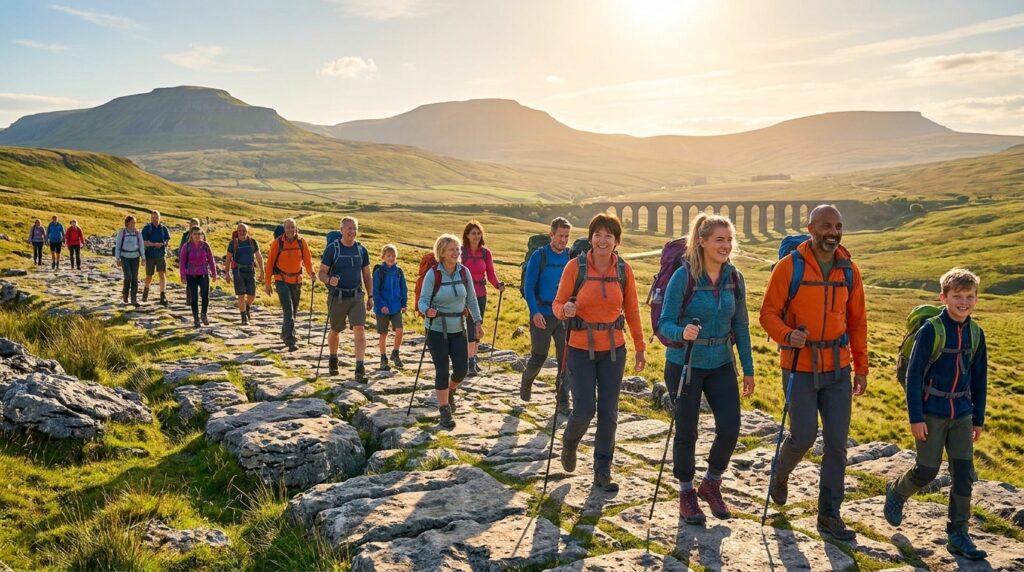
Rolling limestone moorland leading to three distant hill silhouettes representing Pen-y-ghent, Ingleborough, and Whernside. A small stylized train is visible curving through a distant valley, suggesting the rail route that links the peaks. Golden-hour light and soft clouds emphasize the wild, raw beauty of the Yorkshire Three Peaks area.
Experience on the Yorkshire Three Peaks hike and train route
Step off the carriage in Settle or Horton-in-Ribblesdale and the pace changes instantly. The air turns cooler. Sheep graze on limestone grass. Paths climb quickly, exposing gritstone steps and slabs of pale limestone. Each summit — Pen-y-ghent, Whernside, Ingleborough — reaches about 700 metres, compact, wind-scoured crowns offering broad views.
The terrain is varied. Low moorland gives way to limestone pavement and deep pot-holes. You cross peat hags and grassy ridges. On steeper flanks you navigate flagged paths and loose scree. The Norber Erratics stand like weathered sculptures on limestone shelves. Their rounded boulders tell a glacial story beneath your boots.
Traveling by train sharpens the contrast. A calm carriage ride becomes a wildwalk within an hour. Trains set the rhythm: morning light through carriage windows, then the quiet crunch of boots. The railway weaves below limestone scarps and the Ribblehead viaduct looms as a reminder of Victorian engineering.
Expect sharp weather changes. Wind and drizzle can reduce visibility. On clear days the light is remarkable. Valleys open into long views. Stones cast long shadows. Groups move in small knots; solo walkers stop often to take it in.
As Chris Moss observed in The Guardian, “It’s a warm, dry day and, even if it were not, limestone drains better than most types of terrain.” The paper’s coverage called it “a landscape raw and wild”: by train to the heart of the Yorkshire Three Peaks. Those words capture the mixture of accessible transport and uncompromising upland character.
The day feels elemental. Rail convenience frames a demanding, intimate mountain experience. Every summit rewards effort with sweeping horizon lines and quiet that lingers long after the return train.
| Train leg | Service frequency | Nearest station for hike | Hiking segments served | Approx. hiking time | Best time for micro-adventure |
|---|---|---|---|---|---|
| Leeds ↔ Settle | 20 services/day Mon–Sat; 11 on Sun | Settle | Pen-y-ghent (direct access), start of Three Peaks loop | Pen-y-ghent: 1.5–2 hrs ascent/descent; Full 3‑peaks loop: 6–8 hrs | Late spring–early autumn (May–Sep); early morning departures; weekdays less crowded |
| Settle ↔ Carlisle | Regular Leeds–Settle–Carlisle line (same frequency) | Horton-in-Ribblesdale / Ribblehead | Whernside and Ingleborough approaches; access to Ribblehead viaduct | Whernside: 2–2.5 hrs; Ingleborough: 1.5–2 hrs; Inter-peak crossings 2–3 hrs | Clear days for visibility; avoid heavy rain/winds; allow for train times for return |
Note: Total walking time for the full Yorkshire Three Peaks loop is typically 6–8 hours; check timetables and daylight before you go.
Practical tips for planning your micro-adventure on the Yorkshire Three Peaks hike and train route
A rail-linked day in the Three Peaks rewards careful sequencing. Below are focused, actionable tips to keep the trip safe, efficient, and memorable.
- Gear essentials
- Sturdy waterproof boots with good grip on limestone and flagged paths.
- Layered clothing: breathable base, insulating mid-layer, and a waterproof shell.
- Lightweight map (paper) and compass; GPS as backup. Mobile signal can be patchy on the moors.
- Trekking poles for steep descents and peat hag crossings.
- Basic first-aid, emergency whistle and a headtorch with fresh batteries.
- Weather and terrain considerations
- Limestone drains rapidly; underfoot can be firm after rain, but local hollows stay boggy. Choose footwear and gaiters accordingly.
- Expect fast-changing conditions on the tops; carry waterproofs even when the valley is clear.
- Early season can leave patches of snow or very wet sections—check conditions before you leave.
- Train access and timing
- The Settle to Carlisle rail route remains an excellent access corridor and is celebrating 150 years of service—making day returns practical for many walkers.
- Use morning departures to maximise daylight. Allow margin for slower group pace and photo stops.
- Consider a single-peak plan (Pen-y-ghent or Ingleborough) if train timings are tight.
- Route, logistics and local resources
- Start or finish at Settle, Horton-in-Ribblesdale or Ribblehead viaduct depending on your chosen loop.
- Check the Yorkshire Dales Explorer resources and local station facilities for seasonal service changes.
- Carry sufficient food and water; refill options are limited on the moors.
- Safety and etiquette
- Tell someone your intended train times and route. Buy a flexible return ticket if available.
- Respect grazing livestock and follow the Countryside Code.
Plan deliberately, travel light, and use the railway as a reliable frame for an adventurous, scenic day in the Dales.
Conclusion
Combining a scenic rail journey with a day of rugged upland walking makes the Yorkshire Three Peaks hike and train route a rare and rewarding micro-adventure. A morning carriage through patchwork dales leads to compact, wind‑scoured summits and distinctive limestone features. The contrast between the calm of the train and the elemental character of the moors is central to the route’s appeal.
This day-trip suits anyone seeking a full outdoor experience without overnight gear. With sensible kit, checked timetables, and an eye on weather, the route delivers big views, geological curiosities such as the Norber Erratics, and the satisfying rhythm of footfall and rails. It is approachable yet testing: short steep ascents, exposed ridges, and wide horizons that reward effort.
Use the information in this guide to plan deliberately. Book flexible rail tickets, leave margin for changing conditions, and pick a start that matches your pace. For further curated routes, inspiration, and practical ideas visit LeisureQuest — a guide that helps people explore, play, and keep learning.
Take the train, lace your boots, and turn a single day into a memorable upland story.
Frequently Asked Questions (FAQs)
When is the best time to do the Yorkshire Three Peaks hike and train route?
Late spring to early autumn (May–September) offers the most daylight and firmer ground. Start early in the morning to avoid crowds and capture the best light. Limestone drains quickly, so recent heavy rain can leave hollows boggy even if ridges are firm.
Do I need to book train tickets in advance?
Booking is helpful but not always essential. The Leeds–Settle–Carlisle route runs frequently (about 20 services a day Mon–Sat; 11 on Sundays). Buy a flexible return if your finish time might change. Check timetables on the day for disruption.
How hard is the hike and how long will it take?
The full Three Peaks loop typically takes 6–8 hours and includes steep short ascents to summits around 700 metres. It is moderately hard—suitable for walkers with good fitness and basic navigation skills. Consider single-peak options if you prefer a shorter day.
What gear should I bring?
Sturdy waterproof boots, layered clothing, waterproof shell, map and compass (GPS as backup), headtorch, spare batteries, trekking poles, first-aid kit, food and water. Gaiters help in wet hollows.
Which stations are best for access and are facilities available?
Settle, Horton-in-Ribblesdale and stations near Ribblehead offer direct access to routes and the Ribblehead viaduct. Station facilities vary—plan for minimal services and use local resources like the Yorkshire Dales Explorer for updates.