
Call the Midwife: A Warm Welcome to Community Stories
Call the Midwife opens as more than a period drama; it feels like a neighbor knocking and offering tea. For decades this series has captured hearts with its intimate view of mid-20th century community health, the quiet bravery of nurses and midwives, and the social issues that shaped lives. Its enduring appeal lies in small moments — deliveries at dawn, whispered confidences, and the steady work of care that knits neighborhoods together.
This article will explore why Call the Midwife matters beyond entertainment. We’ll look at its portrayal of poverty, public health, and changing social attitudes, and how those themes echo in books, films, and modern conversations about community care. Expect nostalgic storytelling grounded in hard realities, and a supportive tone that honors the people at the series’ center.
Whether you’re a longtime fan or new to the world of Nonnatus House, you’ll find insight and recommendations ahead — from related media to thoughtful reflections on community resilience. Pull up a chair; let’s begin with compassion and curiosity.
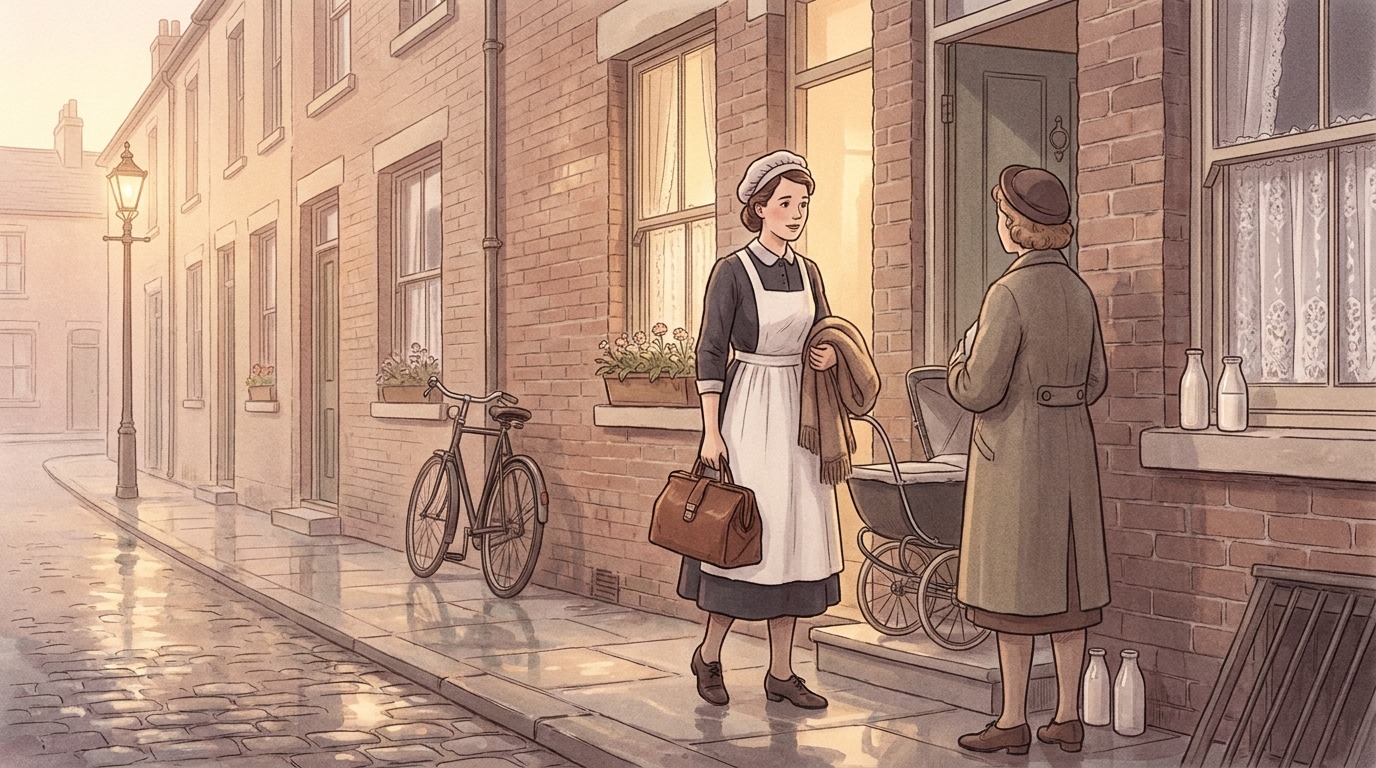
A warm, early-morning street scene in a mid-20th century East London neighborhood. A midwife in a period uniform walks along wet cobbles, carrying a leather medical bag and a folded blanket. A pram sits outside a doorway while a neighbor chats. Terraced brick houses, lace-curtained windows, window boxes, a leaning bicycle, and a milk crate add authentic period detail. Soft golden light and muted pastel tones give the scene a nostalgic, film-like quality.
Call the Midwife: Insights and Cultural Impact
From memoir to television
Call the Midwife began its life on the page. Jennifer Worth’s memoirs, first published in 2002, provided intimate, ground-level accounts of mid-20th century nursing and midwifery in East London. The BBC adapted those recollections into a series that balances tender human moments with hard social realities.
Adaptation kept the memoirs’ warmth while expanding their canvas. Producers and writers drew on historical detail to create a believable community where medical care, faith, and neighborhood solidarity intersect. The result is drama that feels both personal and civic — stories about individual births and broader shifts in public health.
Why the series matters: community, resilience, and social conscience
At its core, Call the Midwife is a show about people who do essential work quietly and consistently. It highlights:
- How community health initiatives shaped postwar Britain.
- The daily labour of nurses and midwives in under-resourced neighborhoods.
- Social issues such as poverty, housing, and maternal care brought into public discussion.
These themes give the series cultural weight. Viewers respond not just to plot, but to the realism and compassion stitched through each episode. Critics and fans alike call it “a rich portrait of a strong, resilient community.” That line captures why the series endures: it honors ordinary courage.
Key facts
- Based on Jennifer Worth’s memoirs (published 2002).
- Produced by the BBC, now in its long-running life on television.
- Frequently cited alongside period pieces like Made in Dagenham, Vera Drake, and Philomena for its social themes.
Cultural ripple effects
Call the Midwife helped normalize conversations about maternal health and working-class experience on mainstream television. It inspired renewed interest in nursing memoirs, historical podcasts, and community-focused documentaries. The show also broadened the audience for period drama that foregrounds social reform and public-health history rather than only aristocratic stories.
Quotes and named connections
“Call the Midwife has been around for a long time—perhaps longer than you think,” one observer noted, reflecting on the show’s roots and reach. Actors and filmmakers who work on related projects often point to the series as an example of storytelling that combines tenderness with social urgency.
Seen through the lens of memoir and careful production by the BBC, Call the Midwife remains a culturally significant drama. It reminds us that healthcare, community, and storytelling are deeply intertwined, and that resilience often grows in the quiet work of neighbors and carers.
| Title | Type | Year | Main themes | Notable cast / author |
|---|---|---|---|---|
| Call the Midwife (memoir) | Book (memoir) | 2002 | Midwifery, community health, postwar East London | Jennifer Worth (author) |
| Call the Midwife (TV series) | TV series | 2012–present | Period drama, maternal care, social issues, community resilience | BBC production; Jenny Agutter, Helen George |
| Vera Drake | Movie | 2004 | Reproductive rights, class, stigma | Imelda Staunton |
| Made in Dagenham | Movie | 2010 | Labor rights, gender equality, working-class solidarity | Sally Hawkins |
| Philomena | Movie | 2013 | Institutional abuse, motherhood, memory | Judi Dench |
| Brooklyn | Movie | 2015 | Immigration, identity, women’s choices | Saoirse Ronan |
Legacy and Influence of Call the Midwife
Call the Midwife has quietly shaped how audiences understand mid-20th century women’s work. Beginning with Jennifer Worth’s firsthand recollections and growing into a long-running television staple, the series turned intimate caregiving into mainstream cultural conversation. As one observer put it, “Call the Midwife has been around for a long time—perhaps longer than you think,” a reminder that its roots and resonance extend beyond broadcast schedules.
Its influence appears in several areas:
- Renewed interest in nursing memoirs and oral histories, prompting reprints and new collections.
- Greater public attention to maternal and community health campaigns, with charities and educators using the show as a touchpoint.
- A shift in period drama storytelling toward working-class and healthcare-focused narratives.
The program also elevated the visibility of women’s roles in community health. Through careful character work and storytelling, it revisited midwives, nurses, and local volunteers as agents of change rather than background figures. That narrative choice helped normalize serious discussions about poverty, housing, and reproductive care on mainstream television.
Culturally, Call the Midwife opened space for complementary projects. Films like Vera Drake and Made in Dagenham, and stories such as Philomena and Brooklyn, occupy related ground; together they create a richer picture of mid-20th century women’s lives and struggles. The series’ long run — now in its 15th season — gave these conversations sustained exposure, letting themes of resilience and community reverberate across media.
For viewers and communities, the show serves as both balm and provocation. Its warmth affirms caregiving as profoundly human work. Its willingness to confront difficult social issues asks audiences to remember the past with empathy and to consider how community health matters today. In that dual role, Call the Midwife has become a gentle but persistent force in cultural storytelling.
Conclusion
Call the Midwife leaves a lasting impression: a portrait of mid-20th century community health, women’s labor, and quiet resilience. Across memoir and television, it turns personal caregiving into a public conversation that still matters.
The series’ roots in Jennifer Worth’s memoirs and the BBC’s careful production created storytelling that balances tenderness with social urgency. Viewers find emotional truth in childbirth scenes, neighborhood bonds, and the everyday work of nurses and midwives.
Culturally, the show broadened what period drama can be. It opened space for nursing memoirs, films about social justice, and renewed interest in community health histories. Its long run — now in its 15th season — has kept these themes visible and relevant.
Emotionally, Call the Midwife comforts and challenges. It honors compassion, highlights systemic inequities, and encourages empathy for lives often overlooked. That dual role is why it continues to resonate.
If you want to explore these stories further, LeisureQuest acts as a curated guide that helps turn free time into small quests of exploration, play, and learning. Visit LeisureQuest to find recommendations that pair well with the show’s themes.
Thanks for reading — may these stories inspire curiosity, kindness, and a renewed appreciation for community care.
Frequently Asked Questions (FAQs)
What is Call the Midwife?
Call the Midwife began as Jennifer Worth’s memoirs, later adapted by the BBC into a period TV series. It follows midwives and healthcare workers in mid-20th century East London, blending intimate personal stories with broader social and public-health issues.
Who are the main cast and characters?
The ensemble includes actors such as Jenny Agutter and Helen George alongside many others who portray midwives, nuns, doctors, and neighbours of Nonnatus House. Characters represent a cross-section of working-class life and the professionals who served them.
What themes does Call the Midwife explore?
Key themes include maternal and community health, poverty and housing, reproductive care, social reform, and the changing roles of women. The show emphasizes resilience, compassion, and the communal networks that supported families.
How many seasons are there and where can I watch it?
The series has run for many seasons and is now in its 15th season. In the UK it airs on the BBC and is available on BBC iPlayer. International viewers can often find it on PBS Masterpiece, regional broadcasters, or streaming services that carry BBC content.
Why should newcomers watch Call the Midwife?
New viewers gain a warm, realistic portrait of postwar community life and healthcare. The series is both comforting and thought-provoking; it humanizes caregivers, highlights historical social issues, and invites reflection on how communities care for one another.
If you have more specific questions—about episodes, historical accuracy, or recommended companion reads—see the article sections above or explore resources and memoirs that inspired the show.