Robotic Meal Preparation for Nonprofits: How Technology is Revolutionizing Charity Kitchens
Nonprofit kitchens are stretched thin. Volunteers are harder to find. Demand keeps rising. How can nonprofits serve more meals with the same or fewer hands? Robotic Meal Preparation for Nonprofits offers a practical answer. Small, precise robotic arms can portion, scoop, and plate at scale. They reduce repetitive strain. They improve consistency. They free staff to focus on nutrition and dignity. This technology is not about replacing people. It is about amplifying capacity. It helps organizations handle surges, meet safety standards, and make volunteer time more meaningful.
Across charity kitchens, pilots are showing faster assembly times and steadier quality. Why does that matter? Better meals mean better outcomes for the people served. This introduction previews how robotic arms, AI, and human caregivers can form a resilient partnership. In the sections that follow, we will explore practical setups, cost considerations, and real-world lessons from early adopters. If your nonprofit runs a pantry, meal program, or community kitchen, this technology might expand what you can offer without losing the human touch.
Robotic Meal Preparation for Nonprofits: Impact in San Francisco’s Tenderloin
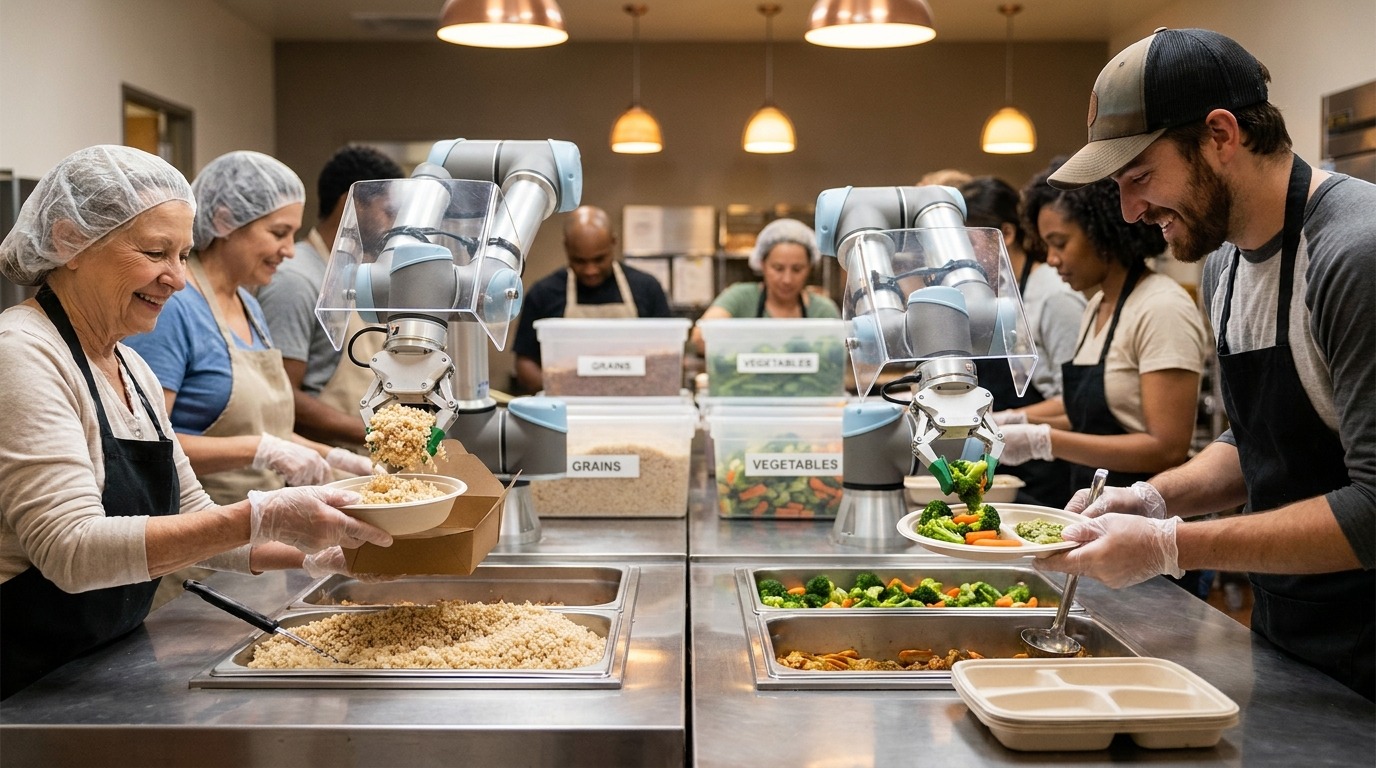
Project Open Hand’s Tenderloin kitchen shows how Robotic Meal Preparation for Nonprofits can change day-to-day operations. Facing chronic volunteer shortages, the nonprofit introduced two robotic arms from Chef Robotics. The arms run for about two hours each day to help assemble meals. They handle roughly 70 different ingredients and operate alongside human volunteers. Staff members note the real gain is reliability. “It’s not even that they’re faster. It’s that we don’t have the volunteers.”
In practical terms, these robotic arms turn manual bottlenecks into predictable workflows. Portion sizes become repeatable. Cross-contamination risk falls with automated scoop-and-place motions. Meal assembly times stabilize during peak windows. Volunteers are redeployed to tasks that require judgment, like meal quality checks and client interaction. Inventory planning improves when machines follow consistent portion rules.
Key benefits:
- Reduces dependence on variable volunteer availability.
- Delivers consistent portions and plating every shift.
- Lowers repetitive strain injuries for staff and volunteers.
- Integrates with complex menus—about 70 ingredients in current pilots.
- Frees human time for nutritional counseling and dignity-focused work.
Challenges overcome:
- Reconfiguring kitchen layouts for robotic reach and safety.
- Training staff to operate and maintain ‘physical AI’ systems.
- Funding initial hardware and pilot integration.
- Adapting motions for varied food textures and temperatures.
Project Open Hand’s pilot shows a replicable model. Robotic Meal Preparation for Nonprofits in the Tenderloin demonstrates tech can amplify capacity without replacing care. The result is steadier service and more resilient kitchens.
Innovations in AI and Physical Robotics for Nonprofit Meal Prep
Chef Robotics is building what practitioners call “physical AI.” This approach pairs perception, motion planning, and end-effectors to solve messy, real-world food tasks. Instead of only reasoning in code, the system senses force, texture, and position. It adapts motions for different ingredients. That makes it a core example of AI in charity work and food robotics that matters in practice.
At the heart of physical AI is software that treats movement as an adjustable parameter. “Having an arm and a scooping motion turns a physics problem to a software problem.” With the right motion profiles, the robot handles soft beans, firm proteins, and saucy sides with predictable results. Cameras and sensors detect fill level and consistency. Control loops adjust speed and pressure on the fly.
How this improves nonprofit meal prep:
- Consistency: repeatable motions cut portion variance and reduce waste.
- Flexibility: motion libraries let teams switch menus quickly.
- Safety: automated handling reduces cross-contamination risks.
- Efficiency: machines perform repetitive tasks, freeing staff for client-facing work.
Scaling and operational gains
- Remote updates let nonprofits receive new recipes and motion profiles without hardware swaps.
- Data from each run informs portioning, inventory, and scheduling decisions.
- Modular tooling supports different end-effectors for scooping, pouring, and plating.
In short, Chef Robotics applies food robotics and AI in charity work to make complex assembly solvable, scalable, and safer. The result is technology that augments human caregiving instead of replacing it.
Volunteer vs Robotic Meal Assembly: Quick Comparison
| Mode | Speed | Accuracy | Consistency | Volunteer Availability | Cost | Scalability |
|---|---|---|---|---|---|---|
| Volunteer meal assembly | Variable; can be fast but often unreliable — “It’s not even that they’re faster. It’s that we don’t have the volunteers.” | Moderate; subject to human error and fatigue | Variable across shifts and teams | Limited; chronic shortages in places like the Tenderloin | Low upfront costs; ongoing recruitment and scheduling expenses | Limited; scaling depends on volunteer recruitment and retention |
| Robotic meal preparation | Consistent operating speed during runs; pilots use two robots about two hours daily | High; repeatable motions and sensor feedback improve accuracy | High; repeatable portioning and plating | Reduces dependence on volunteers; works alongside humans | Higher initial capital and integration costs; lower variable labor cost over time | High; modular tooling, remote updates, and data-driven scaling; handles ~70 ingredients |
CONCLUSION
Robotic Meal Preparation for Nonprofits is reshaping how charity kitchens meet rising demand. Technology brings predictable portions, safer handling, and steadier throughput. It does not replace care. It amplifies it. When robotic arms take on repetitive tasks, staff and volunteers focus on client dignity, nutrition, and personal connection.
The most important shift is collaboration. Humans provide judgment, empathy, and quality control. Robots supply repeatability, endurance, and data. Together they make meal programs more resilient against volunteer shortages. They also open paths to scale services without sacrificing standards.
This change matters beyond efficiency. It creates safer workplaces and reduces burnout. It frees time for training, menu development, and direct service. It also makes room for learning: volunteers and staff gain new skills working with physical AI and food robotics.
LeisureQuest celebrates that intersection of curiosity and community. Our mission is to inspire exploration and learning in everyday life. See how technology and service blend into meaningful leisure and civic engagement at LeisureQuest. Consider robotic meal prep as both a practical tool and a learning opportunity. The future of nonprofit foodservice looks cooperative, humane, and hopeful.
Frequently Asked Questions (FAQs)
What is Robotic Meal Preparation for Nonprofits and how do the robots work?
These systems pair food-safe robotic arms with “physical AI”—force sensors, cameras, and motion libraries—to automate repetitive tasks like scooping, portioning, and plating. Operators load ingredients and select a recipe profile; the robot follows calibrated paths and adjusts pressure and speed in real time. For a technical deep-dive, see the “Innovations in AI and Physical Robotics for Nonprofit Meal Prep” section above.
Will robots replace volunteers in nonprofit kitchens?
No. In practice robots handle repetitive, ergonomically risky work while volunteers move into client-facing roles, quality control, and training. The Tenderloin pilot described earlier shows volunteers redeployed to dignity-focused tasks, not displaced—robots stabilized operations during volunteer shortages while staff focused on nutrition counseling.
What costs should a nonprofit expect and how can they fund adoption?
Expect higher upfront capital for hardware and integration but lower variable labor costs and fewer injury-related absences over time. Funding routes that nonprofits commonly use include grants, corporate sponsorships, equipment leasing, and phased pilots. Tech profiles of vendors such as Chef Robotics highlight pilots that reduced labor reliance and improved throughput—see Chef Robotics and the TechCrunch profile for examples.
How scalable is robotic meal prep across nonprofit foodservice operations?
Highly scalable when implemented modularly. Key enablers are modular end-effectors, remote recipe updates, and data-driven portion libraries. These let a single platform move from a two-hour daily run to multiple shifts or additional sites with minimal retraining.
What is the future outlook for AI in charity work and food robotics?
Costs are likely to fall as adoption grows; software-driven updates will broaden menu coverage; and workforce programs can convert equipment into training opportunities. For real-world context and community impact, see Project Open Hand and the Tenderloin impact section in this article.